
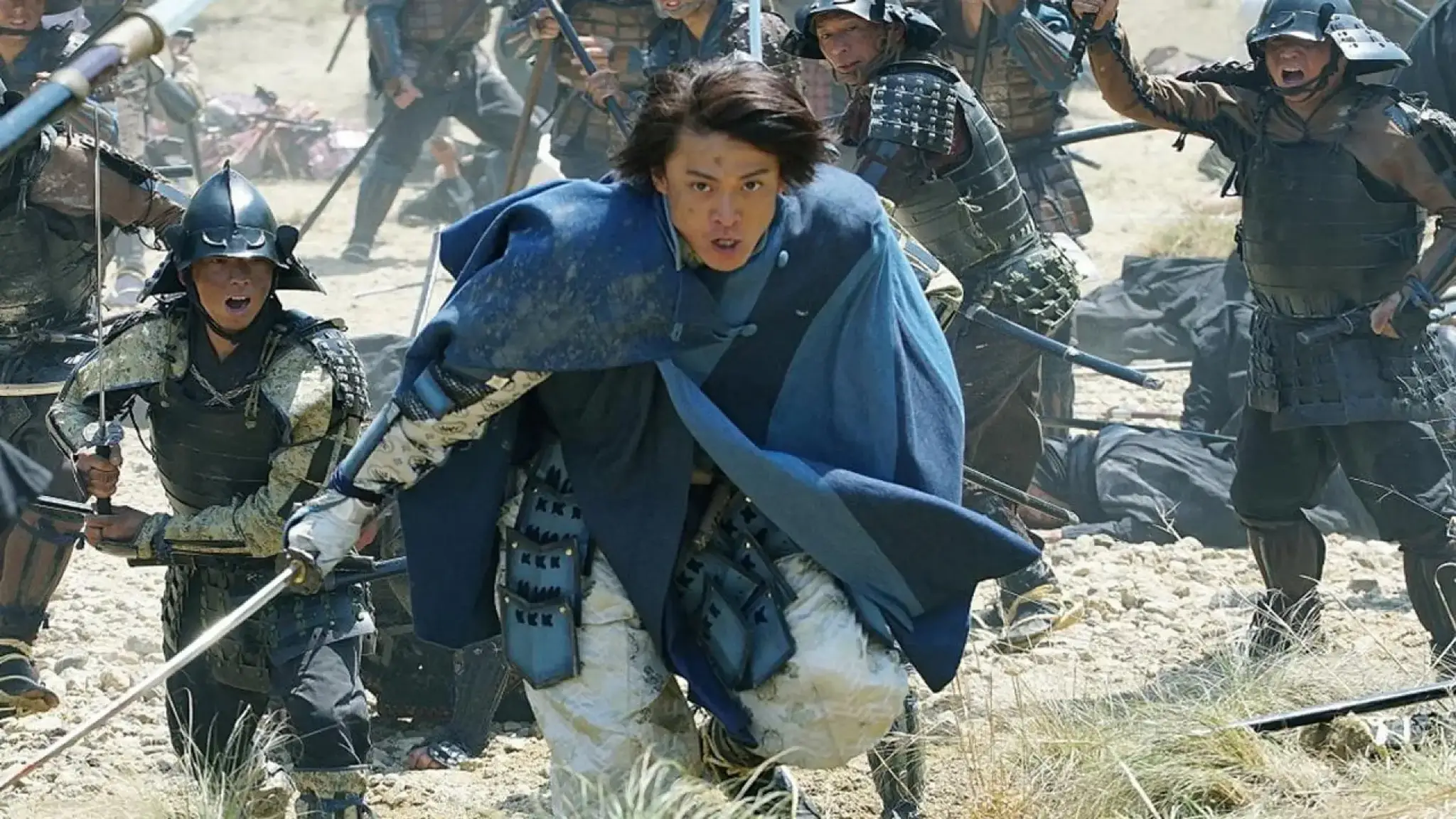
Nobunaga Concerto: The Movie follows a high school student named Saburo (Shun Ogiri).
One day, Saburo falls into a time slip and arrives in the Sengoku period of 1549. There, he meets the ailing head of the Oda clan, Nobunaga Oda (also played by Shun Oguri). Due to their striking resemblance, Nobunaga asks Saburo to take his place as warrior chief.
Following this fateful encounter, Saburo eventually learns everything he needs to know to lead and embody Nobunaga. He earns the respect of his subjects, the loyalty of his retainers, and the love of his betrothed, Lady Kichō (Kō Shibasaki). With his unprecedented power and influence, he sets out to unify the country of Japan.
However, a few hurdles stand in the way of his grand ambition. The first is the secret scheme of a general named Hashiba Hideyoshi (Takayuki Yamada) to overthrow Nobunaga. Hideyoshi harbors deep resentment after the real Nobunaga pillaged his village and killed his family. And there is no better time to seek revenge and claim power than when the great warlord is on the cusp of success.
The second is that the real Nobunaga Oda has returned under the name of Akechi Mitsuhide. Even though he is technically the rightful and most powerful Daimyo in Japan, he has a serviceable relationship with Saburo and has chosen to stay in the shadows as one of his vassals.
The third obstacle is the biggest of all. According to historical accounts, Nobunaga Oda died in 1582 at the hands of Akechi Mitsuhide. If Matsunaga Hisahide (Arata Furuta) is correct that all major historical events still unfold despite the Saburo and Nobunaga switchup, then it may be Saburo’s fate to die soon as well.
There’s a bit of a learning curve to keep up with this film, and that is kind of expected since this appears to be the ending of a popular TV series in Japan. Fortunately, the first three minutes are dedicated to retelling the vital moments of the series. Although, I still felt the need to write down names on paper since there are a lot of them. It turns out there are only four characters you need to keep in mind: Nobunaga Oda, Akechi Mitsuhide, Hashiba Hideyoshi, and Saburo.
Two of the characters I mentioned above are played by Shun Oguri, which is a tough assignment to pull off. Whether you’re new to his work or already a fan of his previous projects, he always proves that he’s a reliable actor. Even without having seen the series, I found myself engaged and rooting for him here.
Furthermore, Nobunaga Concerto: The Movie is a good introduction to the rich history of Japan. Not all of it is accurate because of the sci-fi elements. But a good chunk of it is still factual, which is praiseworthy. They managed to create a product that is both fact-based and interesting enough to find yourself slipping back to 16th century Japan to learn more about the personality, achievements, and death of the so-called “Great Unifier.”
The story is good, but I understand it is not for everyone. It can get a little confusing at times, and there are moments where you may find yourself losing focus. Beside the talks of peace, siege, and betrayal, the film inserts a teenage romance that I personally feel indifferent about.
The other noteworthy aspect of the film is its production. Most modern Jidaigeki (period dramas) are usually small in scale because large battle set pieces are obviously expensive. But this film was able to enlarge the scale and make it look epic, with shots of hundreds if not thousands of extras in full costume fighting in the field.
Nobunaga Concerto: The Movie is the perfect example of the relationship between history, series, manga, anime, and film. You can definitely consume it as it is because the film is kind enough to loop you into all the previous happenings before the incident that leads to Nobunaga’s end. But you might feel that it is a bit lacking. That is because this is only one medium, and to fully appreciate, understand, and feel the weight of everything at stake, you would have to trace the story back to its roots.
3/5
Now streaming on JFF Theater.