
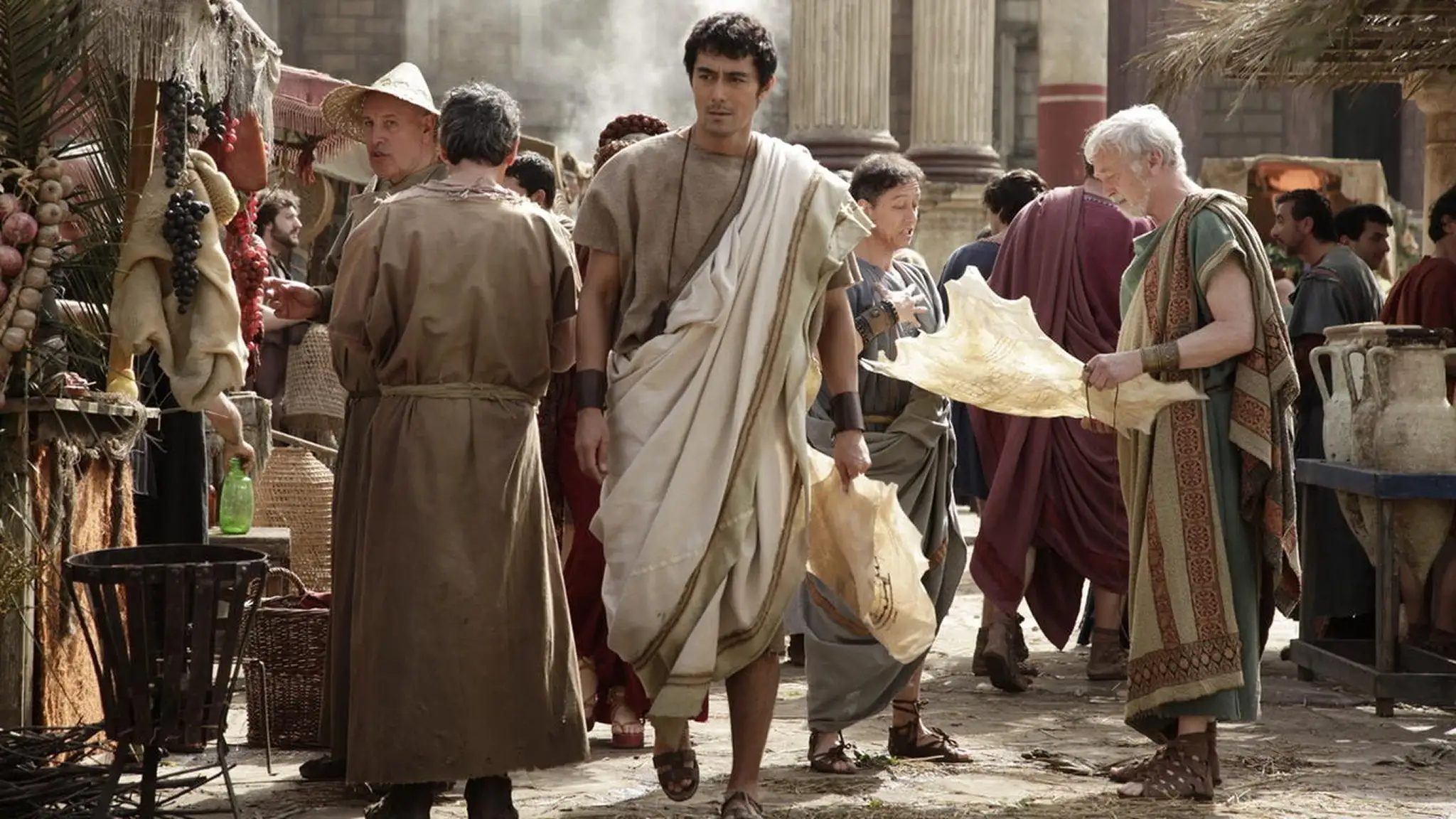
Thermae Romae follows the journey of bathhouse architect Lucius Modestus (Hiroshi Abe).
The year is 128 AD. Rome is at the peak of its flourishing economy under the rule of Emperor Hadrian (Masachika Ichimura). During the zenith of this boom, bathhouses (or thermae) dotted every street of Rome.
But despite the growing number of bathhouses and their patrons, we meet Lucius getting fired from his job as an architect. The reason is that his designs are outdated and people want something new.
He is stumped. He cannot think of anything innovative for his designs. Out of frustration, he submerges himself underwater to think. He then discovers something below, a water vortex. Curious, he checks it out, but gets sucked into it.
The next thing he knows, he is in a modern sentō. There, he marvels at the technology and convenience of Japanese bathhouses, from woven baskets for the personal belongings of regular visitors to cold fresh milk perfect for after every bath. He immediately thinks to himself that he could bring these ideas back to Rome.
When he does get back to his time, Lucius immediately goes to work, introducing all the brilliant ideas he gathered from his brief journey to the future. As expected, it is a major hit and his name becomes the talk of the town.
It is not long before Emperor Hadrian himself requests his service. The Emperor is impressed by his work and wants Lucius to build him a private bath, something that has never been seen before.
Lucius accepts the offer, but there is one big problem: his mind is drawing blanks again. He needs to go back to the future to get more ideas. But how can he do that if the first time was by accident?
Thermae Romae’s premise sounds like a joke. The execution also looks like a joke because the film is set in Rome yet all the people speak Japanese and all key characters are Japanese. On top of all that, the film wants us to take it seriously, as it is surprisingly rooted in history. There is a real effort and research put into this, and the people and events mentioned here actually happened in real life.
Hence, it is impossible not to admire the dedication put into making it. Even if it can come off as a very long running gag and it is hard to take it seriously, it is not shallow or sloppily made. There is a certain care put into it that will make you appreciate it as a film: the Latin texts and costume designs are on point, Roman bathing culture is depicted perfectly, and there are convincing shots of the bustling streets of Rome and the interiors of old palaces and bathhouses.
As for the story, I would say that it is only absurd on paper. Once you hear the justification of it, you will actually find it to be a very intriguing topic.
You see, bathhouses served as social and political hubs for Romans. Since bathing was a communal activity, people would converse and discuss topics for long hours. Even more importantly, the film presents the bathhouse as culture itself, vital to control, peace, and power. A military can only do so much to supervise every corner of a vast empire like Rome. But by giving people a shared identity, shared practices, and shared values to believe in, they will want to be part of the empire, and in effect, infighting and war become avoidable.
It’s a lesson in history so minuscule in scale that you will not see it as something very important. But because of this film’s ridiculous premise, you will begin to see the significance of such detail in the grand scheme of things. You learn from it, and that is how you know that the film is not actually ridiculous. It’s actually very smart and earnest in educating people on how the things we often overlook actually matter.
Perhaps the only real challenge this film presents is that its 108-minute runtime can truly exhaust the fountain of ideas it has and the patience you will give it. Eventually, it becomes repetitive. Lucius arrives, marvels at something, cries, gets transported back, applies what he learned. It then relies on a raw political and romantic subplot to keep itself going, as the time travel gimmick seems like it is no longer working. It is almost a guarantee that you will find it a bit boring.
In my opinion, Thermae Romae is not for everyone. It can be for history buffs or for fans of the anime and the manga. But for casual viewers, they need to condition themselves for the film they are about to watch, because it can swiftly shift from the principles of ruling a vast nation to a man in awe of a self-cleaning bidet toilet. And I think the true value of this film lies in connecting those two wildly opposite scenarios together.
3/5
Now streaming on JFF Theater.