
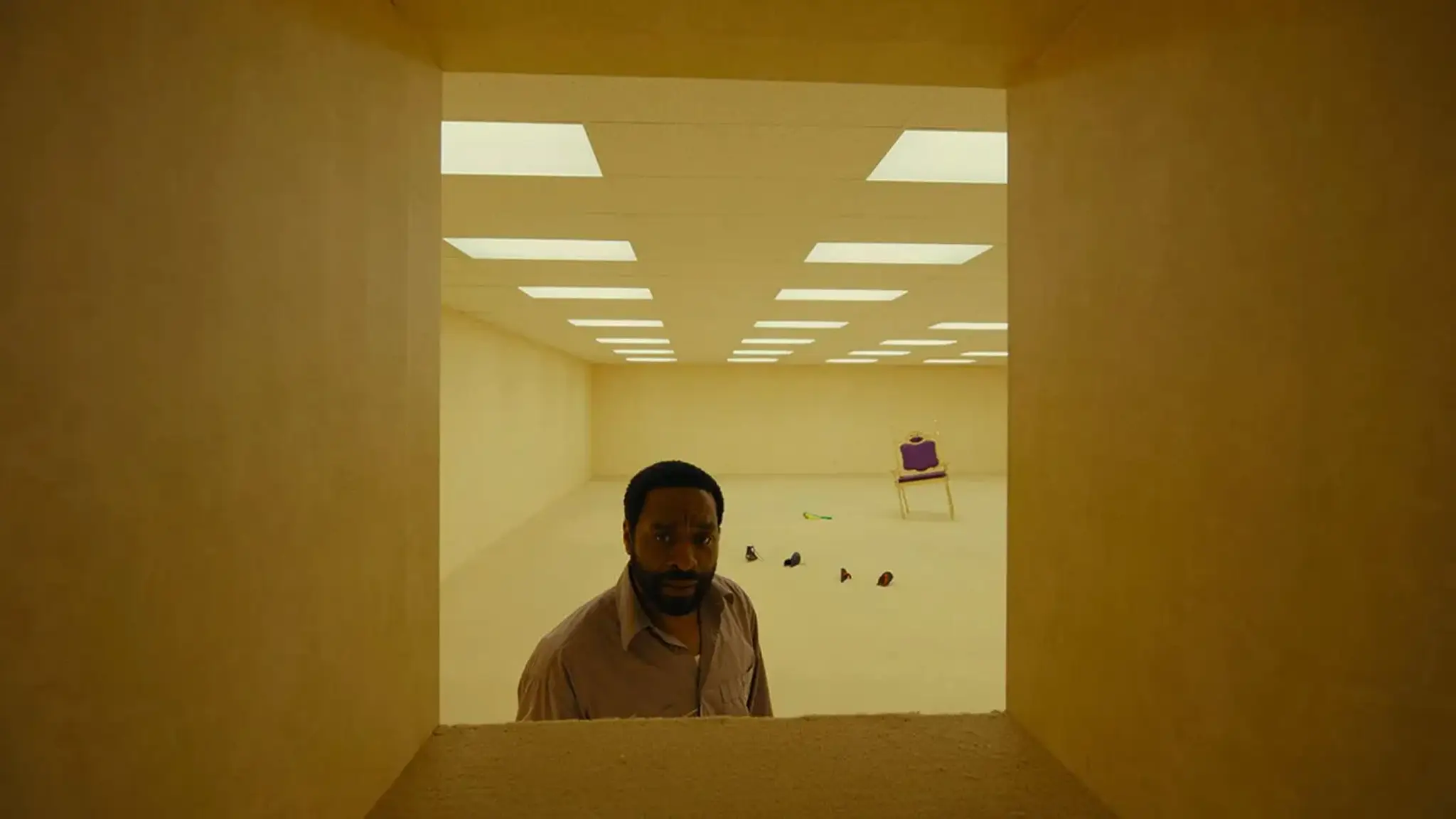
Backrooms is what they call the infinite labyrinth of empty yellow rooms that seems to exist in another dimension. No one knows why or how the backrooms exist. It’s just… there.
Before Clark (Chiwetel Ejiofor) discovered the backrooms, he was busy keeping his furniture store afloat. He’s not actually a businessman; he’s an architect. But he is left with no choice but to spend all of his time making silly TV advertisements with his assistant (Lukita Maxwell) and her boyfriend (Finn Bennett).
His struggle goes way beyond finances, though. The first time we meet Clark, he’s in a therapy session with Dr. Mary Kline (Renate Reinsve). They discuss Clark’s recent divorce and try to process it by reenacting the moment he got kicked out of his own house by his wife for his alcoholism.
Clark is insecure, bitter, and broken. So when he discovers the backrooms, he is instantly drawn into them. It starts as curiosity about its never-ending hallways, oddly placed doors, and weird architecture. But it slowly becomes a refuge for him—a liminal space away from all the insecurities and failures he suffered in the real world.
Dr. Mary Kline grows concerned with her client, so she decides to check on him.
Little did she know that this decision to visit him and enter the backrooms would lead her not only to come face to face with creatures lurking in it but also to confront her deep-seated memories of trauma, displacement, and loss.
Just like the backrooms in Backrooms, this film came out of nowhere. I doubt it’s on everybody’s radar, especially when we consider that it’s going toe to toe with the juggernaut franchise Star Wars on its release date.
It has some interesting background and fun facts. It originates from a four-year-old found footage YouTube video, it’s an A24 distribution, it’s backed by respected horror directors Osgood Perkins and James Wan, and it’s directed by the 20-year-old Kane Parsons. All of this is compelling, but we all know that none of that is enough against a well-known IP.
All I’m saying is, this film has all the cards stacked against it, like timing, budget, and fanfare. But surprise surprise, this film has already earned around 150 million dollars as of the time of writing. Of course, that is not Star Wars numbers. It’s not beating Mandalorian and Grogu in the box office anytime soon. But that’s a very impressive feat to pull off if your budget is just 10 million dollars. A quick math shows that’s a 1,500% return on investment!
The budget constraint also meant that during production, they had to create the set practically in lieu of using CGI. That turns out to be the best decision for Parsons and company because the physical set makes the hallways of the backrooms feel alive. It gives us a sense of tangibility and authenticity. The liminal space becomes a real character itself, growing and evolving alongside the people traversing it.
Now, the casting. I’m honestly still surprised by the casting of Chiwetel Ejiofor and Renate Reinsve. With their caliber, I never expected them to play characters in a low-to-mid-budget horror film. But they are reliable actors, and their performance here is a testament to how good they are at their craft. No matter what the material is, they can make it a hundred times more engaging.
Perhaps the thing that I think is holding this film back is oddly the way it feels very A24-ish. In all fairness, I liked the 90s look of it, especially when it transitions to the grainy videos, as it aids the horror and will really force you to look closely at the screen. But Backrooms can sometimes be all aesthetics. A bit of breadcrumbs to follow and pieces to puzzle together might be nice; it’s just that this film has the tendency to forgo explanation, leaving you more confused rather than satisfied.
In my opinion, a film’s ability to stay vague throughout is both a strength and a weakness. To some, the flexibility to come up with your own understanding of the film is the epitome of modern horror storytelling. It elevates the genre to the next level and makes watching films more purposeful and meaningful. While to others, the ambiguity makes it rather a tedious and frustrating watch than something to carry with you easily as you head out of the theater.
After watching Backrooms, I would say that I experienced both. I feel like the vagueness makes it such a rich story, but there’s sure a lack of context to really make sense of it.
Furthermore, it really all boils down to preference. If you’re into the A24 kind of film, then this is just right up your alley. But those expecting closure might find the incompleteness exasperating.
3/5
Now showing in cinemas.