
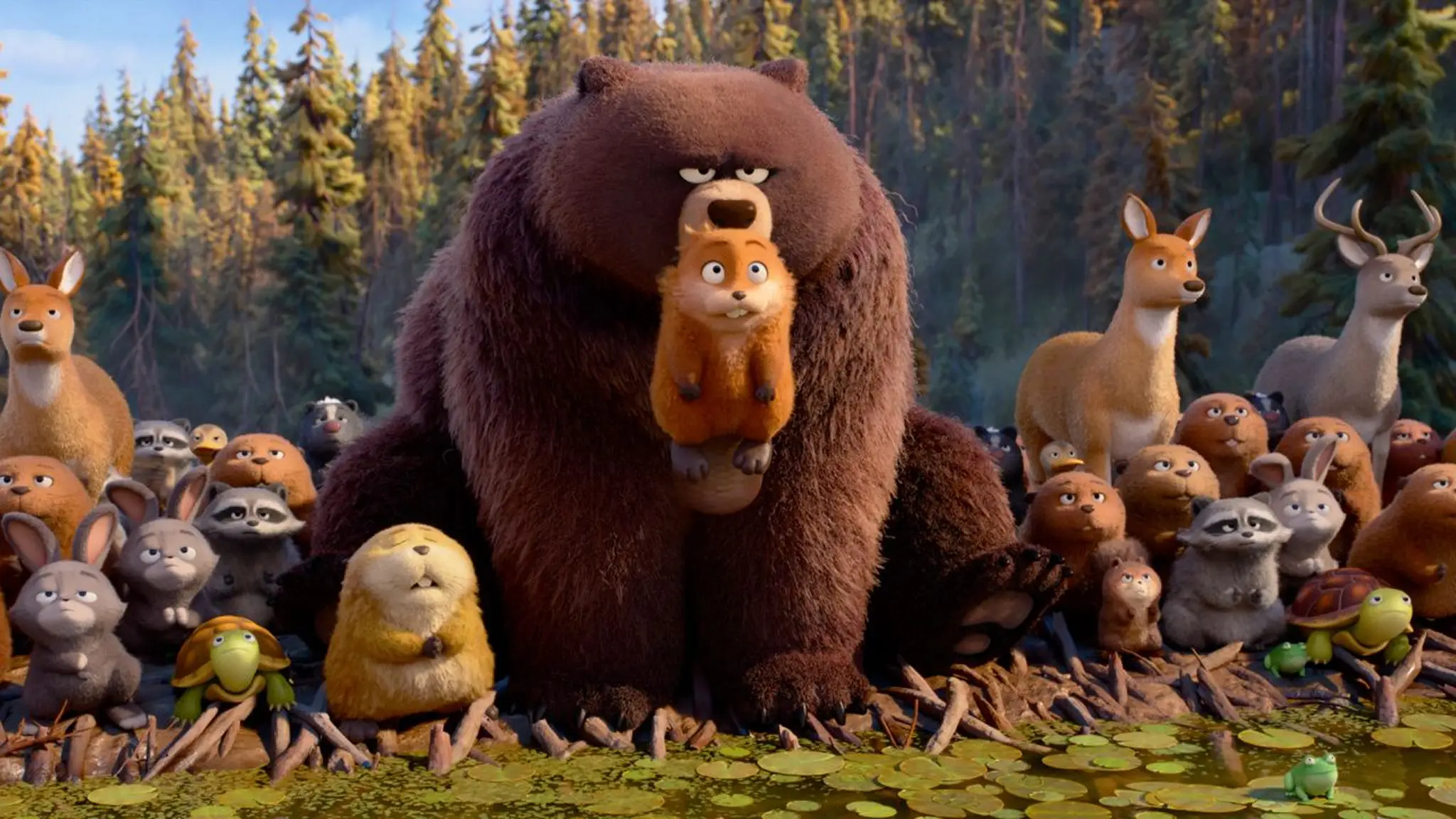
Hoppers is about a girl named Mabel Tanaka (Piper Curda).
Young Mabel spends her days with her grandmother sitting on a rock in a local forest glade. Her grandmother taught her a trick that makes staying there pretty enjoyable. In order for it to work, Mabel must stay completely still and let the world around her happen. And slowly, the animals living in the area start to show up: beavers, frogs, fishes, birds, and deers. A sight so fascinating, alluring, and heartening. Because of her grandmother’s love for nature, she begins to develop a deep passion for protecting and saving it.
Years pass, and Mabel, now a teenager, learns that her arch nemesis Mayor Jerry Generazzo (Jon Hamm) plans to replace the glade with a freeway. To fight the construction, Mabel spends days gathering signatures all over the city of Beaverton. Unfortunately, no one wants to sign it. She also learns that animals are no longer living in the glade. For some reason, they are all gone.
Mabel then discovers and follows a beaver heading to her university. As it turns out, her biology professor Dr. Samantha “Sam” Fairfax (Kathy Najimy) and her colleagues are building a hopping technology that can transfer human consciousness into a robot animal. The technology’s aim is immersion, giving scientists a way to live among the animals they are studying.
Upon hearing Dr. Sam’s explanation, Mabel gets an idea. She will transfer her consciousness into a beaver to find more beavers and convince them to return to the glade. Beavers are industrious builders, and once they build a dam, animals will return and inhabit the abandoned glade.
It’s perfect!
But Dr. Sam does not agree because it will directly interfere with nature. Even if Mabel is well-meaning, that is not the way to do it. Besides, where would she even find beavers? It is not like they have a secret community that she can infiltrate or something.
Beavers are crazy cool and director Daniel Chong probably believes that too, because these fluffy little animals are not only cute to look at but are also ecosystem engineers that help everyone else survive. They do this by building dams, primarily to store food and provide protection. In doing so, the dam slows and pools fast-moving streams, transforming rushing water into calm, shallow wetlands that fish, amphibians, birds, insects, reptiles, and even humans depend on to survive.
The lesson in Hoppers is much like the lesson we can get from watching beavers: you don’t have to force the world to change. If you want it to be better, then you just have to show up, be fully present, be your true self, and make room for good things to happen.
Mabel learns this the hard way. For most of the film she is constantly rushing, protesting, arguing, and interfering, because her passion for saving the animals is real and urgent and she cannot imagine doing anything less for them. But the more she forces it, the worse things get. She soon finds out that listening to others and building relationships with people and nature matter as much as righteous conviction.
This is where Pixar and Disney usually thrive: they create simple stories like this that are fun to discuss with children and for adults to ponder on the way home. And I am glad Pixar is returning to this form of layered storytelling, wherein it is not just about an adventure of a girl possessing a robot beaver, it also goes a lot deeper than that, but not so deep that people of all ages cannot enjoy or comprehend it.
It’s a good sign that Pixar is bouncing back from a series of mediocre films like Elio, Elemental, and Lightyear. Yes, they all have good and meaningful qualities. But Hoppers edges them because every element of the film is doing thematic work. Meaning if we changed parts of this film, let’s say beavers to penguins, then the message about being connected would fall apart. Even more so, the rock, the fake trees, the wildfire, and the flood are all pushing toward the same theme of letting nature be.
I like Hoppers. It’s not just a fun family movie with interesting humans, cute beavers, and flying sharks (oh yes, there’s a flying shark here!). Yet it also makes me think and reflect on my relationship with the natural world. The film speaks a lot of hard truths, from the perils of industrialization to the laws of nature. But it’s not shouting at us or preaching to us to go and save ponds, wetlands, or forests. Instead it asks us to sit down and observe, reminding us that we are all part of something bigger and we are all in this together.
4.5/5
Now showing in cinemas.