
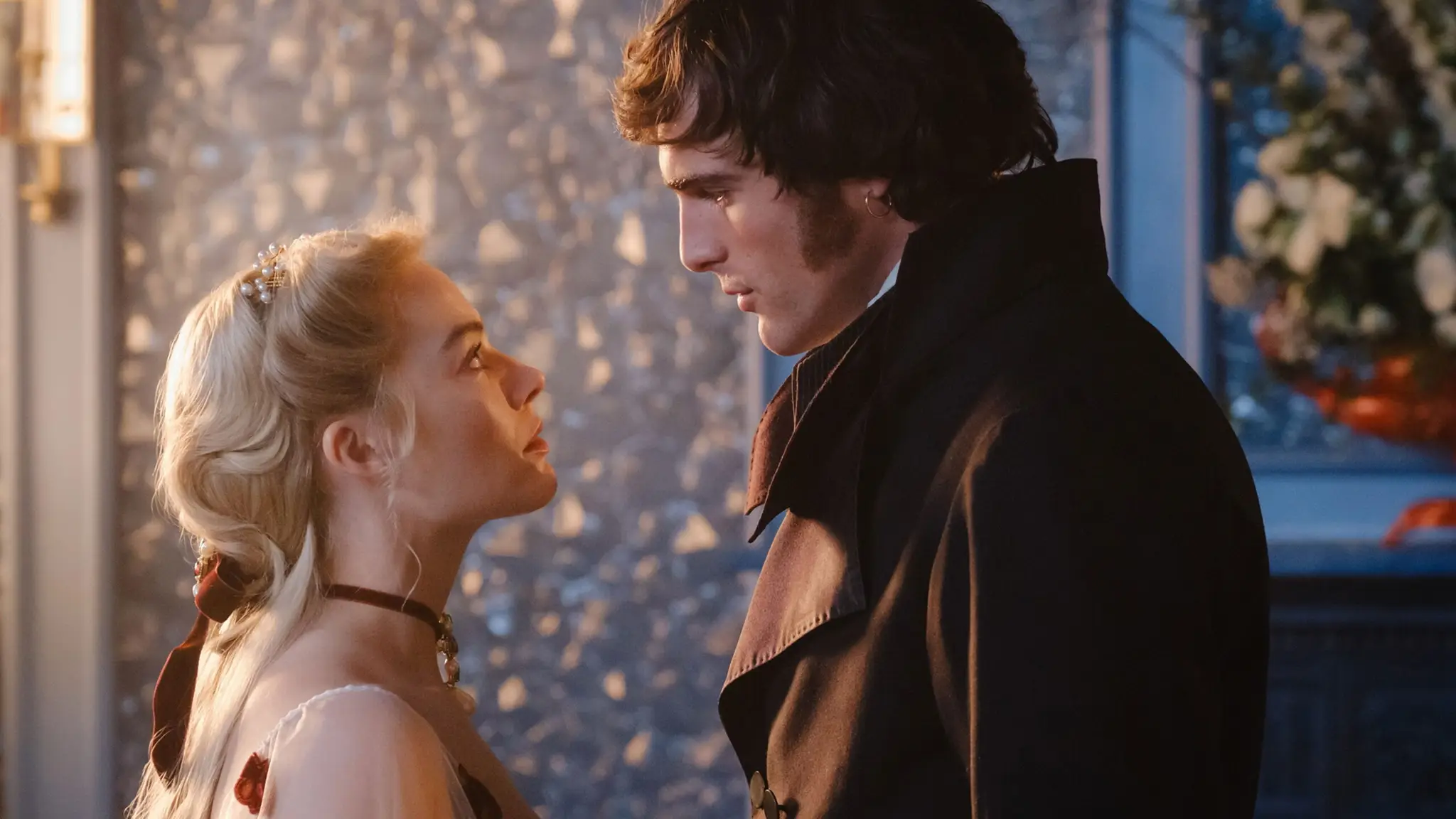
Wuthering Heights is a classic tale about the star-crossed lovers Catherine Earnshaw (Margot Robbie) and Heathcliff (Jacob Elordi).
Catherine lives at the Wuthering Heights estate with her father (Martin Clunes) and her companion and confidant, Nelly Dean (Hong Chau). One day, her father brings home a boy he claims to have rescued. Catherine names him Heathcliff, after her deceased brother.
Despite Catherine sometimes treating Heathcliff as inferior to her, he grows protective of her. At one point, he even takes the blame and a beating from Catherine’s dad for returning home late, leaving him with permanent scars on his back.
Six years pass, and Catherine is old enough to marry. She sees the new, wealthier neighbors, the Lintons, as a family she could join. While spying on them, she falls and sprains her ankle. Edgar Linton (Shazad Latif) then takes her in and cares for her until she is fully recovered.
Weeks later, Catherine returns to Wuthering Heights transformed into a proper lady. She is well-dressed and well-mannered, far from the Catherine she once was. Heathcliff feels bitter because he loves her, and her prestigious appearance only highlights the huge status gap between them. His bitterness deepens into anger when he overhears Catherine confessing to Nelly that she intends to marry Edgar and cannot be with Heathcliff because he’s poor.
Hurt and humiliated, Heathcliff leaves Wuthering Heights.
Many years later, Catherine marries Edgar, and they are expecting a child together. They live at Thrushcross Grange with Nelly and Edgar’s sister, Isabella Linton (Alison Oliver). Despite her comfortable life and the people who love her, Catherine cannot get Heathcliff out of her mind. Perhaps she still loves him.
One day, an enigmatic man appears to Catherine. Handsome, tall, well-dressed, and brooding, Heathcliff has returned. Equipped with wealth and power, he’s determined to reclaim Catherine.
Emily Brontë’s 1847 Wuthering Heights is considered by many as the quintessential Gothic novel, blending intense, tragic romance with dark, supernatural elements. Many people seem to like it because it is not the usual love story we read or see. It’s not a comforting romantic story. It’s more about how love can turn into obsession and how pain can shape a person’s entire life.
I have not read the novel though, and the only time I encountered this story was through its Philippine adaptation, Hihintayin Kita sa Langit by Carlitos Siguion-Reyna. Through that film, it’s already clear to me that Wuthering Heights is far from the romantic tale Warner Bros. Pictures is marketing it as. It’s actually full of people gaslighting, manipulating, love bombing, ghosting, and breadcrumbing each other. It’s toxic as hell.
But I will not lie. In its toxicity, there’s a lot of entertainment to be found.
Wuthering Heights is a conflict-driven story. It is not about one problem that the couple resolves over time with their love for each other. This story does not resolve problems, it escalates them, making them bigger and bigger until it feels impossible to resolve without leaving other people or themselves devastated. It’s chaotic. It’s intense. It’s uncomfortable.
Perhaps that’s the main reason this story is timeless. It runs on very deep emotions like obsession, rage, and desire. And we are fascinated by it because most romantic stories tell us these are emotions we need to control, but Wuthering Heights does the opposite and indulges itself fully in them anyway.
As interesting as all this sounds, let me talk about the film’s production drama because I find it equally interesting. Even before its release, people have been review bombing it for many reasons, but the two most prominent are the whitewashing of Heathcliff and the age difference between Margot Robbie and Jacob Elordi. Emerald Fennell is often at the center of all this criticism, as she provides answers that many consider as inadequate.
Personally, I have no problem with it. I understand that casting two attractive actors is good for marketing the film, especially with its obsessive erotic energy. Both of them perform well too.
However, I also see that some themes may be lost or undermined because the director adapts it according to her own vision. If you are curious why the film is in quotation marks, it’s because, to Fennell, this is a personal interpretation. Yup, a personal interpretation. To purists or readers of the book, that is not what an adaptation should be. That feels like a disservice to Emily Brontë’s novel.
Wuthering Heights is a classic for a reason. It has enduring relevance and significance across time. I think Emerald Fennell’s film does manage to highlight some of the story’s most compelling themes and multi-dimensional characters. I enjoyed the Gothic visual style, from the design of the rooms to the costumes and styling choices. In my books, the film checks a lot of boxes. However, after watching it and reading about it, my conclusion is that this can be better and there’s definitely still a lot of room for a deeper, bolder, and darker interpretation.
3.5/5
Now showing in cinemas.